


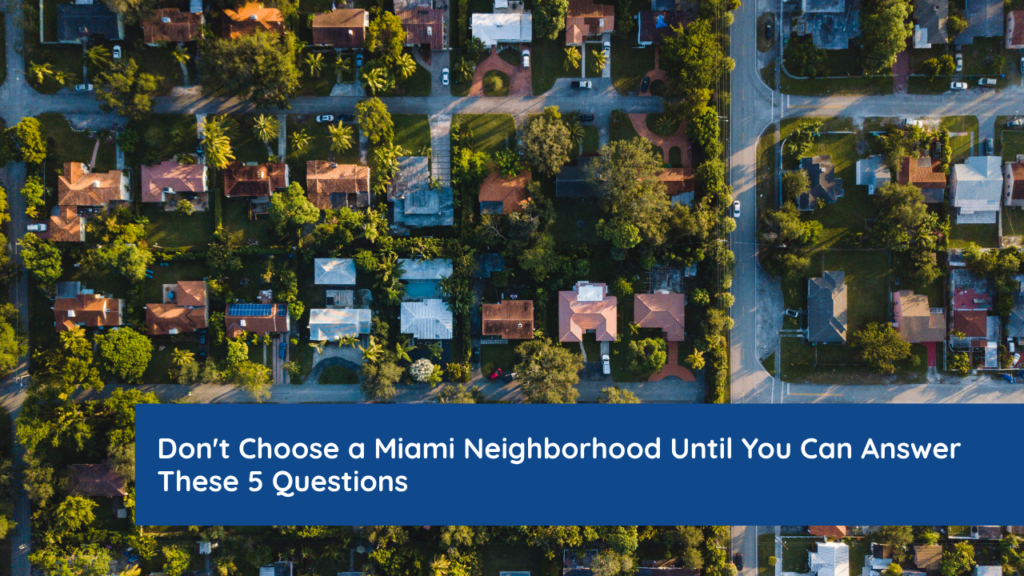
The right neighborhood isn’t the prettiest one — it’s the one that fits your real life
Buyers often fall for a neighborhood’s curb appeal before they understand whether it actually fits their life. This article walks through five questions worth answering before you commit — your real commute time, what’s genuinely nearby, whether the schools fit your family, whether the neighborhood’s style matches how you live, and what the area is likely to look like in five to ten years — with a specific look at how the answers differ across Pinecrest, Coral Gables, The Falls, and Cutler Cay.
Introduction: A Drive-Through Impression Isn’t a Decision
Most buyers choose a neighborhood based on a drive-through impression — how it looks on a Saturday afternoon. That’s a reasonable starting point, but it misses the details that actually determine whether you’ll be happy there in year three, not just on move-in day.
1. How’s the Actual Commute — Not the Google Maps Estimate?
Miami-Dade’s average one-way commute runs about 31 minutes, according to the U.S. Census Bureau’s American Community Survey — longer than the roughly 27-minute national average. But that county-wide figure hides enormous variation. A commute that looks reasonable on a map can turn into 45-plus minutes once you add peak-hour congestion on US-1, the Palmetto Expressway, or I-95.
Before choosing a neighborhood, drive the actual route at the actual time you’d be commuting — not once, but during both morning and evening rush. Pinecrest and Coral Gables residents commuting to Brickell or downtown often face significant US-1 congestion at peak hours; The Falls and Cutler Cay, further south, can mean a longer haul into the urban core, offset for many buyers by more space and a quieter pace. There’s no universally ‘better’ answer here — only the one that matches your actual schedule and tolerance for time in the car.
2. What’s Actually Nearby? (Because “”Nearby”” Means Different Things)
“”Nearby”” is doing a lot of work in most listing descriptions. Nearby to what — a highway on-ramp, a grocery store, a hospital, a park? Before choosing a neighborhood, map out the actual distance and drive time to the specific things that matter to your life: your workplace, your children’s school, a hospital you’d want in an emergency, a grocery store, and any recreational spaces you’d actually use.
Pinecrest offers larger lots and a suburban feel with proximity to Baptist Hospital; Coral Gables combines walkable village-style shopping with proximity to the University of Miami; The Falls centers around retail and the beginning of a wave of renovation and newer construction; Cutler Cay offers gated-community amenities with a quieter, more residential feel. None of these is objectively better — but ‘nearby’ should mean specifically nearby to what you need, not a vague sense of convenience.
3. Are the Schools Really the Right Fit for Your Kids?
School quality is one of the most emotionally weighted factors in a neighborhood decision, and also one of the easiest to get wrong by relying on a single online rating. School boundaries can vary by specific address, not just by neighborhood name, and lines shift more often than buyers expect.
Before assuming a neighborhood’s schools are a good fit, verify the specific assigned schools for the exact address you’re considering — not the neighborhood in general — through Miami-Dade County Public Schools or the Florida Department of Education directly, and consider visiting the campus if it’s a serious factor in your decision. A neighborhood’s overall reputation for schools doesn’t guarantee a specific home falls into the boundary you’re picturing.
4. Does the Neighborhood’s Style Match How You Actually Live?
Pinecrest’s large lots and mature tree canopy suit buyers who want space and privacy. Coral Gables’ Mediterranean Revival architecture and walkable village center suit buyers who want charm and a sense of place. The Falls’ lots suit buyers who want space at a fraction of the cost found in Pinecrest. Cutler Cay’s gated-community structure suits buyers who prioritize security and amenities over historic character.
None of these communities is ‘better’ in the abstract — the right one depends entirely on whether its actual daily rhythm matches how you live, not how the neighborhood photographs.
5. What Will This Neighborhood Look Like in 5 to 10 Years?
A neighborhood you love today can change substantially over the time you own a home there. New construction, commercial development, and zoning changes can shift traffic patterns, property values, and even the character of a street.
Before buying, look into what’s in the development pipeline for the specific area — check with Miami-Dade County’s planning department for pending zoning changes or major nearby projects, and ask your Realtor what’s currently under construction or recently approved in the immediate vicinity. The Falls, in particular, is actively evolving with new residential and commercial development — a genuine opportunity for some buyers and a consideration worth understanding fully for others.
What Does This Mean?
Choosing a Miami neighborhood well means separating the emotional pull of a first impression from the practical realities of daily life there. Verify your actual commute, understand what’s genuinely nearby to what matters to you, confirm the specific schools assigned to the address, make sure the community’s rhythm matches your lifestyle, and understand what’s likely coming next.
Whether you land in Pinecrest, Coral Gables, The Falls, or Cutler Cay, the neighborhoods that serve buyers best are the ones chosen with this level of specificity — not the ones that simply looked good on a Saturday drive-through.
Sources cited: U.S. Census Bureau (American Community Survey, Miami-Dade commuting data).
The Author
Marina Orfali DeRobertis is a seasoned Realtor with Berkshire Hathaway HomeServices EWM Realty and a real estate investor. She brings extensive expertise in South Florida’s real estate landscape and is committed to creating a seamless real estate experience for her clients.
She built a highly accomplished career in business development, with more than 20 years of experience delivering results in sales, multi-million-dollar negotiations, business management, growth strategies, and acquisitions for multinational corporations and real estate investors.
Born in Brazil and based in South Florida, Marina is fluent in English, Portuguese, and Spanish and brings a unique international perspective to Miami real estate.
Whether you’re buying, selling, or investing in Pinecrest, Coral Gables, The Falls, Cutler Cay, or other South Florida communities, Marina combines local market knowledge with sophisticated negotiation and business expertise to help her clients make informed real estate decisions.