

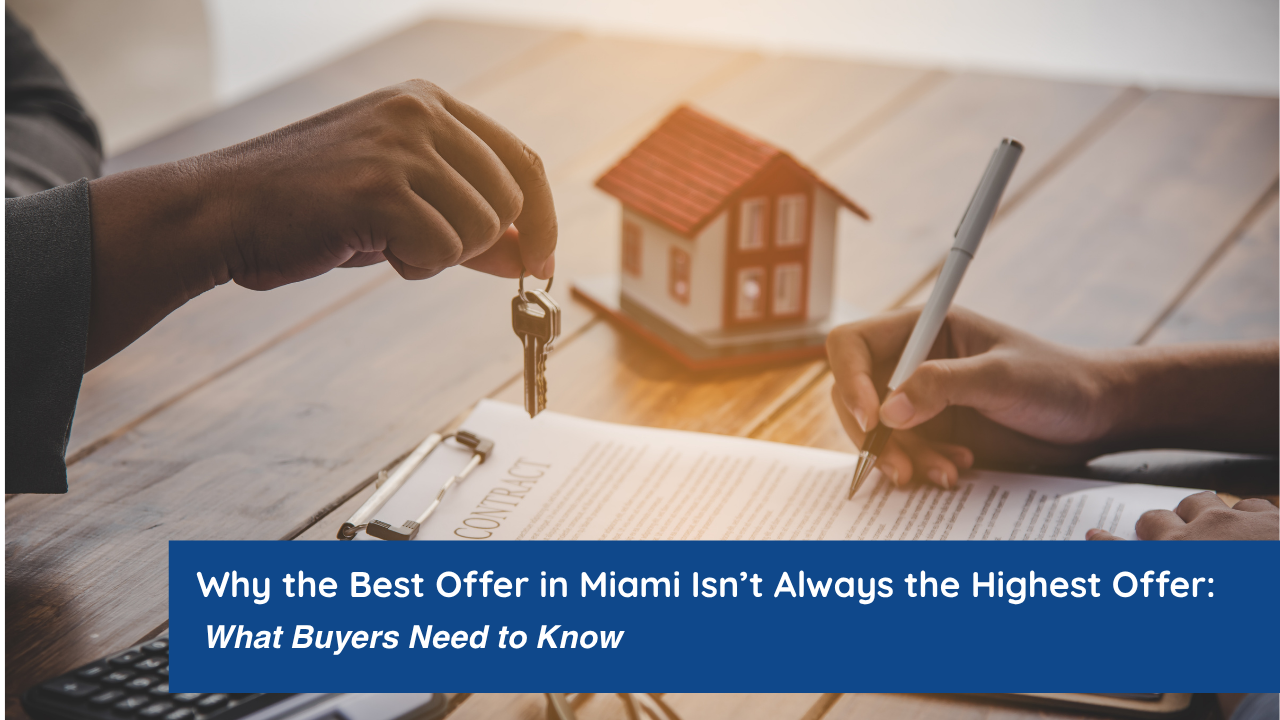
When buying a home in Miami, the highest offer price is not necessarily the strongest offer. Sellers evaluate the entire offer package—including financing, contingencies, deposit, closing timeline, appraisal risk, and the buyer’s ability to actually close. This matters particularly in markets such as Pinecrest, Coral Gables, The Falls, and Cutler Cay, where buyers can face very different levels of competition depending on the property and price point. A buyer offering slightly less but presenting a cleaner, more certain transaction can sometimes be more attractive to a seller than a higher offer with significant conditions attached. Understanding how sellers evaluate offers can give buyers a meaningful competitive advantage before they even begin shopping for a home.
Why Sellers Not Necessarily Choose the Highest Price Offer
One of the biggest misconceptions I see among buyers is:
“If I offer the most money, the seller has to accept my offer.”
Not necessarily.
When a seller receives multiple offers, the decision is rarely based on price alone.
Imagine a seller has two offers:
• Offer A: $1,500,000 with multiple contingencies, a longer closing period, financing, and an uncertain appraisal.
• Offer B: $1,450,000 with strong financing, a substantial deposit, fewer contingencies, a flexible closing date, and a buyer who is already fully vetted by the lender.
Which one is better?
The answer depends on the seller’s priorities—but Offer B may be considerably more attractive.
Why?
Because the seller isn’t simply selling a house. The seller is choosing the probability of successfully closing the transaction.
A contract is only valuable if it actually makes it to closing.
This becomes particularly important in Miami’s higher-end markets.
In Pinecrest and Coral Gables, where many properties are in premium price ranges, sellers may have significant equity and may be less interested in squeezing out every last dollar if doing so introduces substantial risk.
Meanwhile, in The Falls and Cutler Cay, where many homes traditionally fall below the $1.5 million range, buyers may encounter a broader pool of financed buyers—and the strength of the financing and contract terms can become particularly important.
And The Falls is evolving, with new construction adding another dimension to the market and potentially attracting buyers who are comparing newer homes with existing properties.
The lesson?
Price gets attention. Terms can win the deal.
Besides Price, What Are the Components of an Offer?
When evaluating an offer, sellers and their agents typically look at the entire structure of the transaction.
Here are some of the most important components.
1. Purchase Price
Obviously, price matters.
The seller wants to maximize the net proceeds from the sale.
But the offer price should always be evaluated in relation to the other terms.
A $1.5 million offer isn’t necessarily better than a $1.45 million offer if the first buyer has a significantly higher probability of renegotiating or terminating the transaction.
2. Financing
A financed buyer isn’t necessarily at a disadvantage—but the quality of the financing matters.
There is a big difference between:
“I’m pre-approved.”
and
“I’ve been fully reviewed and approved by the lender, subject only to the remaining property-related conditions.”
The stronger the buyer’s financial profile and the more work the lender has already completed, the more confidence the seller can have that the transaction will close.
3. Cash
Cash can be extremely powerful.
A cash buyer removes the mortgage financing contingency and, in many cases, reduces appraisal-related risk.
But even cash offers aren’t automatically the strongest.
A cash offer with numerous contingencies and an inflexible closing may still be less attractive than another well-structured offer.
4. Earnest Money Deposit
The amount of the deposit can communicate how serious a buyer is.
A stronger deposit can provide additional confidence to the seller and demonstrate that the buyer has meaningful financial commitment to the transaction.
5. Inspection Contingency
Inspection contingencies are important protections for buyers.
But from a seller’s perspective, the scope and duration of the inspection period can affect the attractiveness of the offer.
A buyer who asks for extensive contingencies may create more uncertainty than a buyer who has a shorter, clearly defined due-diligence period.
6. Appraisal Contingency
This can be especially important when financing is involved.
If the property doesn’t appraise at the purchase price, the buyer may need to bring additional cash to the closing table—or renegotiate.
From the seller’s perspective, an offer that addresses potential appraisal risk can be stronger than one that leaves the seller exposed to a potential price reduction later.
7. Closing Date
This is one of the most underestimated components of an offer.
Sometimes a seller wants a quick closing. Other times, they need more time. Perhaps they’re purchasing another property. Maybe they need time to relocate. Maybe they have children finishing the school year. Or perhaps they simply want to stay in the home for a few additional weeks.
A buyer who can accommodate the seller’s preferred closing timeline can sometimes create significant goodwill.
8. Other Contract Terms
There can also be other terms that influence the attractiveness of an offer, including:
- Financing terms
- Seller concessions
- Personal property requests
- Home warranty requests
- Closing-cost requests
- Escrow terms
- Specific contingency language
- Flexibility around possession
This is why an experienced Realtor doesn’t simply ask:
“How much do you want to offer?” The better question is:
“What offer gives you the best chance of getting the property while protecting your interests?”
Miami Has a Strong Cash Buyer Pool
Miami is different from many U.S. housing markets because of the strength of its cash-buyer population. And this matters when you’re competing for a property.
According to MIAMI REALTORS®, cash purchases represented 35.1% of Miami closed sales in July 2026. In June, cash sales represented 38.1% of closed sales, and in May they represented 38.7%.
So while “almost 30%” understates the current market, the broader point is absolutely valid:
Cash is a major force in Miami real estate. And cash becomes particularly significant at certain price points.
At the luxury end, cash is extremely common. Above the $3 million it becomes important, at $5 million almost half of transactions are cash driven, and MIAMI REALTORS® reported that 87% of $10 million-plus sales were cash transactions year-to-date in 2026.
This is relevant to markets such as Pinecrest and Coral Gables, where luxury single-family homes can command several million dollars.
At the other end of the market, cash investors can also be active in lower price ranges, particularly where properties appeal to investors, second-home buyers, or buyers who are using proceeds from another property.
For buyers looking at properties under approximately $400,000, competition can include investors and other cash purchasers.
So Miami’s cash market isn’t concentrated in only one segment. There is significant cash activity at both the lower end and the luxury end of the market.
And that means financed buyers need to understand how to compete effectively.
What Does This Mean for Buyers in Miami?
The answer depends considerably on where you’re buying and what price range you’re targeting.
Pinecrest
Pinecrest is one of Miami’s premium residential markets.
Buyers are often competing for larger single-family homes, desirable lots, established neighborhoods, and properties that can command significant prices.
Here, buyers should expect that financial strength and overall offer quality can matter tremendously.
A buyer who is financing a $2 million-plus property should be prepared to demonstrate that they can actually close.
A strong pre-approval, substantial down payment, strong deposit, realistic appraisal strategy, and flexibility around closing can all help make the offer more competitive.
Coral Gables
Coral Gables is another premium Miami market where buyers can encounter significant competition, particularly for exceptional properties.
Current Miami-Dade data continues to show strong performance in high-end submarkets, with Coral Gables among the areas experiencing notable price growth.
In this environment, buyers should not assume that simply offering more money will guarantee success.
The seller may be evaluating not only the price but also: “How likely is this buyer to close exactly as promised?”
The Falls
The Falls represents a different opportunity.
Historically, many homes in this area have been positioned below the luxury price points commonly associated with Pinecrest and Coral Gables.
But the market is evolving.
New construction is introducing additional choices and changing the competitive landscape.
Buyers comparing existing homes with new construction need to consider not only price but also condition, renovations, builder incentives, timeline, financing, and the total cost of ownership.
And when multiple buyers want the same existing home, the structure of the offer can make a significant difference.
Cutler Cay
Cutler Cay is another market where buyers are often looking for the combination of a gated community, single-family living, amenities, privacy, and access to the broader Miami area.
Properties in Cutler Cay traditionally fall below the $1.5 million range
Here, a buyer may be competing with both financed buyers and cash buyers. The key is not to automatically assume that the cash buyer will win.
A strong financed buyer can still present an extremely compelling offer by demonstrating financial strength, reducing unnecessary contingencies, offering a strong deposit, and giving the seller flexibility on timing.
What Makes an Offer Weaker—and What Makes It Stronger?
This is where buyers can make a meaningful difference.Let’s look at some common examples.
Offers That Can Be Weaker
Too many contingencies
Every contingency introduces another potential point at which the transaction can be delayed, renegotiated, or terminated.
That doesn’t mean buyers should eliminate important protections.
It means contingencies should be intentional and appropriate for the property and the buyer’s risk tolerance.
Weak or incomplete financing approval
A basic pre-approval letter is helpful.
But a buyer whose finances have already been thoroughly reviewed by the lender can present a stronger profile.
Unrealistic closing date
If the seller needs 30 days and the buyer insists on 90—or vice versa—the mismatch can make an otherwise attractive offer less appealing.
Aggressive seller concessions
Asking the seller to pay for numerous costs can reduce the seller’s net proceeds and make the offer less attractive.
Overreaching after the offer is accepted
Buyers sometimes negotiate aggressively before signing and then continue trying to renegotiate during the transaction.
That can damage trust and create unnecessary friction.
What Can Make an Offer Stronger?
Cash
Cash eliminates the need for mortgage financing and can reduce transaction risk.
Strong financing
If financing is required, a strong pre-approval or, even better, a buyer who has undergone substantial underwriting review can provide additional confidence.
Fewer contingencies
A clean offer can be more attractive—but buyers should never waive protections blindly. The objective is to eliminate unnecessary risk, not important protections.
Strong deposit
A meaningful deposit can demonstrate commitment.
Appraisal strategy
If you’re financing and offering above comparable sales, understanding and addressing appraisal risk can be critical.
Closing flexibility
If the seller wants a quick closing, accommodate it if you can.
If the seller needs additional time, flexibility can make your offer more attractive.
Understanding the seller’s priorities
This may be the most powerful strategy of all. If you know what matters to the seller, you can structure your offer accordingly. Maybe it’s not the highest price. Maybe it’s certainty. Maybe it’s timing. Maybe it’s avoiding repairs. Maybe it’s a clean transaction.
Your Realtor should be finding out.
The Importance of Understanding How Offers Work Before Shopping
One of the biggest mistakes buyers make is starting their home search before understanding their own buying position.
Before you fall in love with a property in Pinecrest, Coral Gables, The Falls, or Cutler Cay, you should know:
How much can I comfortably spend?
How much cash do I have available?
How strong is my financing?
How quickly can I close?
How much flexibility do I have with contingencies?
What happens if the property doesn’t appraise?
What are my absolute deal-breakers?
The answers to these questions determine how competitive you can be.
And this is particularly important in Miami because you’re not always competing against buyers with the same financial profile.
You may be competing against someone with a 20% down payment.
Or someone putting 50% down.
Or someone paying cash.
Or an international buyer purchasing without financing.
Understanding your position before you start shopping helps you make better decisions when the right property appears.
Because when you find the house you love, you don’t want to spend the next several days trying to figure out whether you can actually compete.
You want to be ready.
What Does This Article Mean for Active Buyers?
If you’re actively looking for a home in Miami right now, here’s the biggest takeaway:
Stop thinking only about the price you’re offering. Start thinking about the strength of the entire transaction.
When you’re looking in Miami, your objective isn’t simply to submit an attractive number. Your objective is to create an offer that makes the seller think:
“This is a buyer I can trust to close.”
That means understanding the market. Understanding the property. Understanding the seller’s priorities. Understanding your own financial position. And structuring the offer strategically.
In a market where cash buyers remain a significant part of Miami transactions—and where luxury cash activity is particularly strong—the financed buyer needs to understand how to compete on more than price.
And even if you’re a cash buyer, the same principle applies.
The strongest offer isn’t necessarily the one with the biggest number. It’s the one that delivers the best combination of price, certainty, timing, and terms for the seller.
That’s why having an experienced local Realtor on your side matters.
The right strategy can mean the difference between simply making an offer—and getting the house.
The Author
Marina Orfali DeRobertis is a seasoned Realtor with Berkshire Hathaway HomeServices EWM Realty and a real estate investor. She brings extensive expertise in South Florida’s real estate landscape and is committed to creating a seamless real estate experience for her clients.
She built a highly accomplished career in business development, with more than 20 years of experience delivering results in sales, multi-million-dollar negotiations, business management, growth strategies, and acquisitions for multinational corporations and real estate investors.
Born in Brazil and based in South Florida, Marina is fluent in English, Portuguese, and Spanish and brings a unique international perspective to Miami real estate.
Whether you’re buying, selling, or investing in Pinecrest, Coral Gables, The Falls, Cutler Cay, or other South Florida communities, Marina combines local market knowledge with sophisticated negotiation and business expertise to help her clients make informed real estate decisions.